Home >> News >> Industry News
29th. July, 2026
Search "custom wine box manufacturer" and most supplier pages read the same way: a list of materials, a row of finish options, and a line about low MOQ. What almost none of them mention is the part that actually determines whether your client gets a working relationship or a container full of claims paperwork — how the box is tested before it ever leaves the factory, and what gets checked at each stage of production, not just at final inspection.
That gap is worth closing, because for wine packaging specifically, the stakes are different from a perfume box or a jewelry case. A cracked jewelry box is embarrassing. A cracked wine bottle inside a sealed carton is a liquid damage claim, a soaked shipment, and possibly damage to everything shipped alongside it.
A box that survives being carried across a showroom floor is not the same as a box that survives 10-14 days in a shipping container, several forklift transfers, and a delivery truck that wasn't loaded with wine bottles in mind. The packaging industry has a formal way of answering this: ISTA testing (International Safe Transit Association), which simulates repeated drops from a fixed height — commonly around 36 inches, from multiple faces, edges, and corners — plus vibration and compression testing that mimics a real trailer ride.
Very few wine box suppliers in China openly reference this standard on their product pages, even though it's the actual benchmark that determines whether a design is production-ready or just sample-ready. At Creative Packing, this is built into how we validate a wine box structure before mass production, particularly for multi-bottle sets and cross-border orders heading to Europe or the Middle East on longer transit routes.
Rigid boxes (wood or MDF core): For single-bottle and gift-tier boxes, MDF with veneer or painted finish gives dimensional stability that solid wood can't always guarantee across humid shipping routes — solid wood can shift slightly with moisture changes over a long sea freight leg, which shows up as a lid that no longer sits flush. MDF veneer avoids that variance while still allowing wood-grain or lacquer finishes.
SBS paperboard: For retail-facing single or twin-bottle boxes, 300-400gsm SBS board is the common range — light enough for e-commerce shipping cost, rigid enough to hold shape with a decent lamination or spot UV finish.
Corrugated: For multi-bottle sets (typically 2, 4, or 6 packs), double-wall or triple-wall corrugated with die-cut partition inserts is what actually stops bottles from knocking into each other during transit — not the outer print quality, which is the part most buyers focus on first.
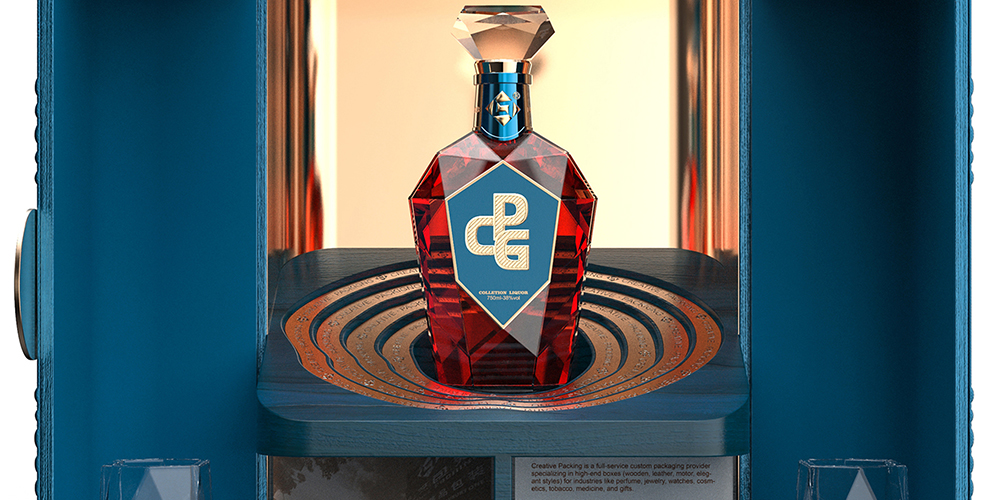
The single biggest cause of in-transit breakage isn't a weak outer box — it's a bottle cavity that's cut 2-3mm too loose. A bottle that can shift even slightly inside its cavity will transfer every drop and vibration impact directly onto the glass shoulder, which is the weakest point on most bottle shapes. This is why bottle-well tolerance is checked during IPQC (in-process quality control), not just measured once on the sample.
Our production QC follows three checkpoints:
· IQC — incoming board/veneer thickness and moisture content checked before cutting starts
· IPQC — bottle cavity fit and structural glue points checked mid-production, not only on the first sample
· QA — final carton inspection before shipment, with drop-test verification available on request for large or long-route orders
Hot foil stamping, embossing, spot UV, and matte soft-touch lamination are all standard offerings across our wooden and paperboard box lines — these aren't unique to wine packaging, so we won't spend three paragraphs on them here. What matters more for wine boxes specifically is making sure finish choices (especially piano lacquer and glossy laminate) don't add slip risk to a box that already needs to be handled carefully.
Creative Packing is ISO 9001 and ISO 45001 certified, FSC-certified for wood sourcing, and BSCI-audited for social compliance — relevant for brands whose own retail or gifting partners require supply chain documentation, which is increasingly common for European buyers in particular.
A wine box that looks right in a sample photo and a wine box that survives a real shipping route are not automatically the same product. The difference comes down to testing methodology and in-process quality checks — the parts of the process that don't show up in a product photo. Dongguan Creative Packing has built these checkpoints into standard production for custom wine boxes, based on nearly two decades of shipping luxury packaging internationally.
Read more:
· 8 Questions Clients Should Confirm Before Customizing High-End Wooden Gift Boxes
· Why Does the Sample Look Great, But Mass Production Often Goes Wrong?
Previous: None
NEXT: None
Phone: +86 13538511868
E-mail: [email protected]
No. 13 Zhan North Road, Baisha Village, Humen Town,Dongguan City, Guangdong Province, China