Home >> News >> Industry News
05th. August, 2026
Quick answer: Anti-tarnish jewelry box lining works by chemically absorbing sulfur gas before it reaches the metal, not by sealing it out — which means the lining has a finite lifespan (typically 1-3 years depending on treatment and use) and stops protecting once it saturates or once pieces are overcrowded inside a compartment.
Most jewelry box RFQs list "anti-tarnish lining" as a single checkbox spec, the same way you'd list a lock or a mirror. That's a mistake, because unlike most packaging features, anti-tarnish lining isn't a static barrier — it's a consumable chemical process. Getting the lining type and the compartment layout wrong doesn't show up in a sample inspection. It shows up months later, when a brand's customer opens a "protective" box and finds a tarnished chain inside it.
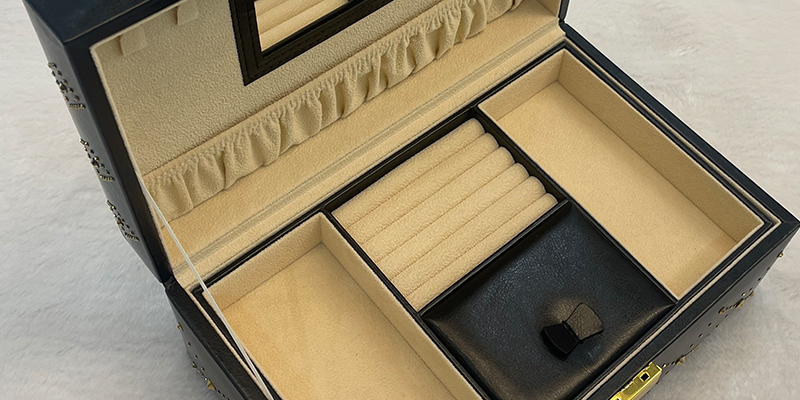
Untreated velvet or standard suede does nothing to prevent tarnish — it's a texture choice, not a protective one. True anti-tarnish lining is chemically treated fabric (commonly a treated polyester suede or microfiber) that absorbs sulfur compounds from the air before they reach the metal surface. It functions less like a shield and more like a sponge: it's actively pulling sulfur out of the enclosed air inside the box.
That mechanism has a direct consequence buyers often miss — the lining saturates over time. Depending on the treatment quality and how often the box is opened, effective protection typically runs one to three years. The signal that it's exhausted is simple and specific: if jewelry tarnishes while stored inside a closed box, the lining has stopped working, not the jewelry.
A chemical sponge only works where it makes contact. This is where compartment layout stops being a purely aesthetic decision and becomes a functional one. A lining can't absorb sulfur from a piece it isn't touching, and it can't protect a piece that's stacked under another one. One piece per slot, with no stacking, is the actual requirement — not a nice-to-have layout preference.
This matters directly for how a jewelry box is engineered: a box with too few compartments for the product line it's meant to hold isn't just a usability compromise, it's a protection failure waiting to happen. A five-slot ring tray holding seven rings means at least two pieces are getting no benefit from the lining at all, regardless of how good the fabric treatment is.
Rhodium-plated sterling silver is increasingly common in mid-to-premium jewelry lines, and it behaves slightly differently in storage. The rhodium layer extends the time before tarnish becomes visible, but it's a thin plating — a scratch from a piece stacked or sliding against another exposes the base metal underneath, which then tarnishes faster than the surrounding plated surface. For brands working with rhodium-plated collections, individual compartments matter even more than they do for plain sterling.
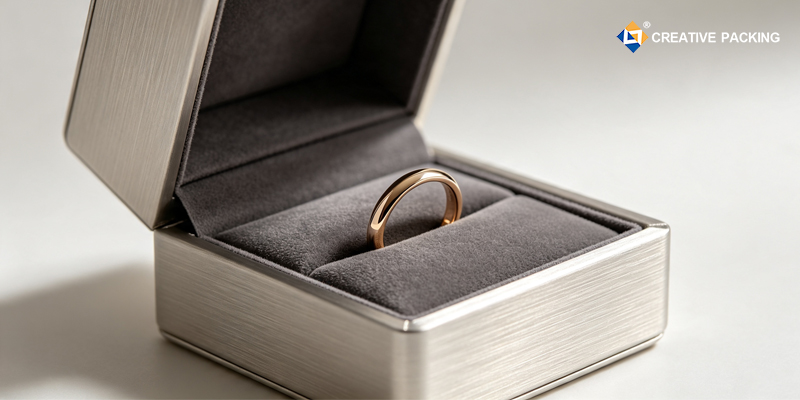
Lining material and treatment — confirm whether the interior fabric is chemically treated for sulfur absorption or a standard decorative velvet/suede with no anti-tarnish function.
Compartment count matched to the actual product line — size the tray to the number of pieces per set, not a generic "multi-slot" layout.
No-stack construction for rings and rhodium-plated pieces — flat, individual slots rather than layered trays for anything prone to scratch-triggered tarnish.
Expected lining lifespan — ask the Jewelry Box manufacturer what treatment is used and roughly how long it remains effective, so this can be communicated in care instructions to the end customer.
| Lining Type | How It Works | Typical Effective Life | Best Suited For |
|---|---|---|---|
| Untreated velvet or suede | Decorative only — no sulfur-absorbing treatment | N/A (no protective function) | Budget lines, non-precious accessories |
| Chemically treated suede/microfiber | Absorbs sulfur gas within the enclosed box air | ~1-2 years | Mid-tier sterling silver and plated jewelry |
| Advanced microfiber (Corrosion Intercept-type) | Higher-capacity sulfur absorption, industrial-grade origin | ~2-3 years | Premium sterling silver, rhodium-plated, flagship collections |
None of these linings work indefinitely, and none of them work in an open or frequently-aired-out box — the sulfur-absorbing effect depends on a relatively enclosed air space, which is another reason lid seal quality and closure type belong in the same sourcing conversation as the lining material itself.
Does velvet lining prevent tarnish on its own?No. Standard velvet or suede is a texture and presentation choice, not a protective one, unless it has been specifically chemically treated for sulfur absorption.
Can a saturated lining be "recharged" or does the whole box need replacing?For most treated fabrics, no — once the treatment is saturated, the fabric itself needs replacing or the box needs replacing, since the sulfur-absorbing compound isn't designed to be reactivated by the end user.
Does this matter for gold jewelry, or only silver?It matters most for silver and silver-based plating (including rhodium over sterling), since gold in typical jewelry-grade purity is far more tarnish-resistant. Mixed collections with both metals still benefit from individual compartments to prevent scratch damage, even where tarnish isn't the primary concern.
Should this be mentioned in the box's included care instructions?Yes — since the lining's protection is finite and condition-dependent (closure habits, humidity, piece count per slot), a brief care note gives the end customer realistic expectations rather than an implied "protects forever" promise the packaging was never designed to keep.
An anti-tarnish jewelry box is only doing its job if the lining chemistry and the compartment layout are specified together — one without the other leaves a real gap in protection that a customer eventually discovers on their own. Creative Packing engineers custom jewelry boxes with lining and compartment specifications matched to a brand's actual product mix, not a generic multi-slot template.
Read more:
Previous: None
NEXT: None
Phone: +86 13538511868
E-mail: [email protected]
No. 13 Zhan North Road, Baisha Village, Humen Town,Dongguan City, Guangdong Province, China