Home >> News >> Industry News
17th. August, 2026
A jewelry box rarely fails where you can see it. The lid shuts, the gold logo reads, the sample gets a thumbs-up. Then a distributor opens the carton a month and a half later and the silver's gone grey or the earrings are rattling loose in the corner. The box did its job as a container. It missed its job as packaging, and your brand eats the cost at the counter.
At Creative Packing, we've built these for 19 years, in wood, leather, and paper, shipped into both the Middle East and the EU/US. The same handful of mistakes shows up every time, so this is the short version of what actually keeps a box honest.
Your liner is what keeps silver looking like silver
Tarnish isn't bad luck. It comes from sulfur in the air, and more often than buyers expect, from the lining they chose because it photographed well. Cheap velvet and flocking leak sulfur and can grey a silver piece in a couple of months sitting in a drawer. At Creative Packing, we test for it properly: a sulfur-free liner declaration backed by an ISO 17075 report, REACH Annex 17 compliance, and batch records. US-bound pieces usually also get asked about California Prop 65 and EN1811 nickel limits.
The liners that don't turn on you are anti-oxidation microfiber, sulfur-free velvet, and acid-free paper. They cost a little more than commodity flocking. They're also why a ring still looks new on arrival instead of needing a polish first. Selling sterling, or anything with nickel? The liner is a spec, not a leftover.
Compartments aren't decoration
Put a necklace, a ring, and earrings in one open well and they'll scratch each other before the box leaves the building. We cut inserts by piece type: a slotted ring row, a clip or channel for the necklace, a separate earring card, a cushioned well for the hero. The aim is zero contact in transit, not a tidy flat-lay. A scratched piece is a return, and on jewelry the return stings because it's usually the hero SKU.
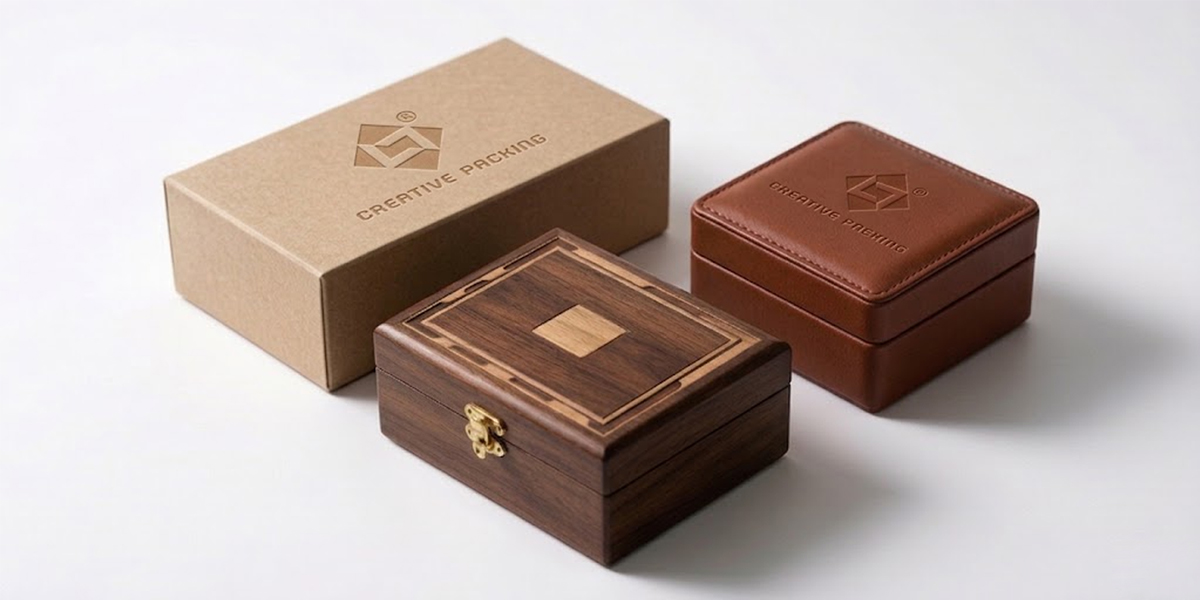
The shapes we make most: a hinged wood box with a lift-out tray, a ribbon-pull drawer paper box, a hexagonal single-ring box, and a travel roll. Don't write off the roll. Collectors and gift buyers carry jewelry, and a leather roll that holds five without bending the straps beats a rigid box that eats half the suitcase.
Wood, leather, paper, and what each costs you
This is where the budget and the calendar meet, and they are not the same animal.
l Wood: Walnut, ash, cherry, or MDF with a real-wood veneer. Solid wood carries the grain and the weight people read as quality; MDF veneer warps less and is kinder on cost at volume. Wood boxes start at 500 pieces and run 45 to 60 days from approved sample to finished goods. Finishes run from open-grain matte to piano-lacquer mirror, distressed, or laser with metal trim.
l Leather: Full-grain, PU, PVC, microfiber, vegan, your call. Leather feels premium and travels, but the minimum is 1,000 pieces and the clock is the same 45 to 60 days as wood. Edge painting and contrast stitching are the difference between a real leather box and a printed one.
l Paper: FSC board, recycled greyboard, art paper, kraft, specialty stocks. Paper is the fast lane: 1,000 to 3,000 minimum and about 30 to 35 working days. Launching a seasonal line or testing a market, paper gets you to shelf quicker than the other two.
The logo finish that survives the shelf
Gold, silver, rose-gold foil, partial UV, 3D emboss and deboss, laser, metal inlay, all fair game. On jewelry, a recessed plate or a blind deboss reads richer than a big foil crest, and a heavy crest is the first thing to scuff in a drawer of boxes. Match the process to the retail price, not the mood board.
What EU and US buyers now ask for on paper
The box isn't just a box at customs. Our manufacturing lines carry ISO 9001:2015, ISO 45001:2018, FSC, and BSCI, and we supply REACH and FDA-available declarations on request. For jewelry, the anti-sulfur test report is what serious importers want before they commit. A supplier who can't show it is telling you something.
The numbers to plan around
Sampling runs 5 to 7 working days for standard builds, 7 to 10 for complicated wood or leather. A new custom sample costs roughly USD 200 to 300 and is usually deductible once your volume hits the agreed number. Budget 45 to 70 days of production after the sample is approved, and pad it if a holiday is breathing down your neck. Reorders get priority scheduling, and we hold the first-order price unless the material or process changes, which we flag before it happens.
Startups and trade shows can get runs of 50 to 200. Perfume and cigar projects tend to bend furthest; jewelry sits in the middle, with wood and leather holding their 500 and 1,000 minimums while paper can start lower.
How the box gets to you in one piece
Outgoing packing matters as much as the box. Creative Packing ships in dust bags inside 5-ply corrugated cartons with foam corners and pearl cotton, under EXW, FOB, CIF, or DDP terms. Payment is normally 30 percent deposit and 70 percent before shipment, with more flexible terms for long-term clients. QC runs incoming, first-article, in-process, and outgoing full inspection, so the glue lines, corners, and hardware on the bulk match the sample you approved.
What to hand your factory before they cut anything
Don't open with "make us a nice jewelry box." Send the real product dimensions, pieces per box, target retail price, and the market it ships to. Those four let a factory pick the liner, the structure, and the material instead of guessing. We hold the approved sample as the reference for bulk, with incoming, first-article, in-process, and outgoing inspection so the carton that lands matches what you signed.
If you're scoping a box now, look at a storage case we've already built and how we lay out compartments by piece, then send your specs to Creative Packing. You'll get a structure recommendation and a quote inside a week.
Previous: None
NEXT: None
Phone: +86 13538511868
E-mail: [email protected]
No. 13 Zhan North Road, Baisha Village, Humen Town,Dongguan City, Guangdong Province, China