Home >> News >> Industry News
26th. August, 2026
Quick answer: A champagne or sparkling wine box can't safely reuse a still wine box's insert spec, because a full champagne bottle weighs roughly twice as much as a still wine bottle, has a wire cage and foil capsule that widens the neck profile, and carries a deep punt base that's structurally weaker than it looks. As a custom wine box manufacturer working across both categories, we treat this as two different engineering briefs, not one template scaled to bottle height.
Brands sourcing a custom wine box for a mixed wine and champagne line sometimes assume one design, scaled to different bottle heights, covers both. It doesn't — and this is a mistake that survives sample inspection just fine, because a single bottle photographs and handles well in a showroom. The problem shows up during freight, when the extra weight and the different neck profile behave differently than the still wine version they were modeled on.
Yes — the difference is larger than most buyers expect. An empty champagne bottle typically weighs 800-900 grams, compared to 400-500 grams for a still wine bottle, and reaches roughly 1.6-1.7 kilograms once filled — close to double the weight the insert and outer structure need to support and immobilize. A foam or corrugated insert engineered around still wine's typical weight range can compress, shift, or fail to hold a champagne bottle securely under the same transit conditions that a still wine box handles without issue.
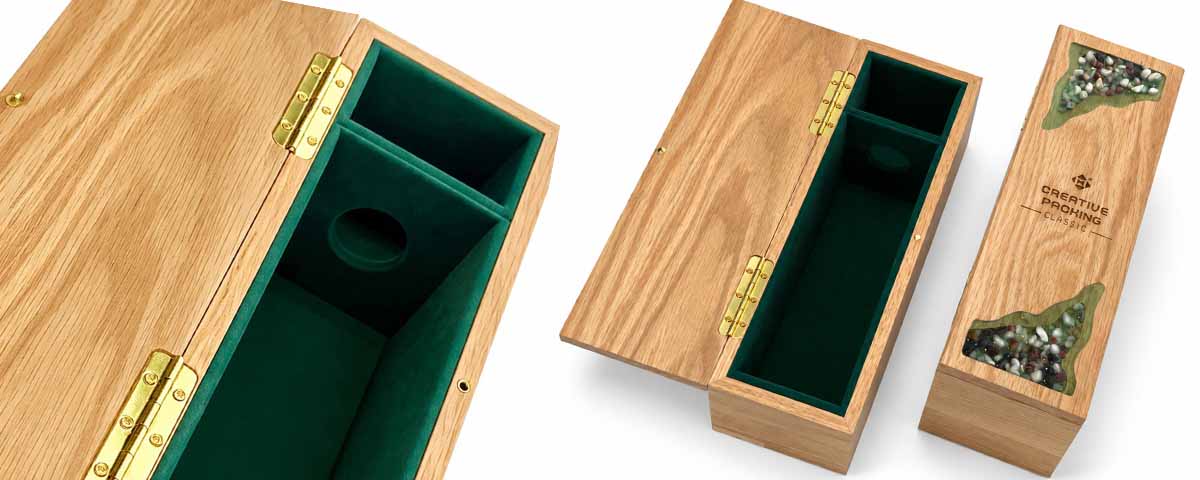
Because the closure hardware is different, not just the cork. A champagne bottle's neck is finished with a wire cage (muselet) and foil capsule (coiffe) over the cork, which creates a wider, less uniform profile than a still wine bottle's simple cork-and-capsule neck. This is exactly the kind of detail a precision-groove insert is built to solve — the cavity has to be cut to the actual hardware profile, not a generic bottle silhouette. An insert cavity cut to a still wine bottle's neck dimensions can pinch or fail to seat a champagne bottle correctly, or leave the cage compressed against the insert material in a way that risks cosmetic damage to the foil capsule during transit.
No — it's a structural feature, and it changes what the box base needs to do. The pronounced indentation at the bottom of a champagne bottle (deeper than on most still wine bottles) reinforces the base against internal pressure, but it also means the bottle's actual point of contact with a flat insert base is smaller and less evenly distributed than a still wine bottle's flatter bottom. A base insert that doesn't account for this can leave the bottle resting on a narrower support ring than it appears to, increasing tip and shift risk during handling.
Weight-rated foam or corrugated grade, not a spec carried over from a still wine SKU in the same product line.
Neck cavity dimensioned for the wire cage and foil capsule, confirmed against actual bottle samples rather than a generic "champagne bottle" template.
Base support engineered around the punt profile, not a flat cavity sized to the bottle's widest diameter alone.
Separate drop and compression testing for the champagne SKU specifically, rather than assuming results from the still wine version transfer directly.
| Factor | Still Wine Bottle | Champagne/Sparkling Bottle |
|---|---|---|
| Typical filled weight | ~1.2-1.3 kg | ~1.6-1.7 kg |
| Neck closure profile | Cork and simple capsule | Cork, wire cage (muselet), foil capsule |
| Base structure | Shallower or flat punt | Deep punt, smaller contact area |
| Insert implication | Standard foam/corrugated spec generally sufficient | Higher weight-rated insert, wider neck cavity, reinforced base support |
Can the same outer box be used for both, with only the insert changed?Often yes, if the outer dimensions accommodate both bottle heights — the insert is usually where the meaningful engineering difference needs to happen, not the outer carton.
Does this matter for single-bottle boxes, or only multi-bottle sets?It applies to both, though the risk compounds in multi-bottle sets, where an underspecified insert affects more than one bottle's stability at once.
Is it more expensive to spec a champagne-specific insert?Marginally, for the higher-density foam or reinforced corrugated material — but it's a small cost relative to the damage claim and reputational cost of a bottle arriving broken or leaking in a gift set.
A champagne bottle and a still wine bottle can sit side by side in a product line and look like a simple height variation, but the packaging engineering underneath them isn't interchangeable. As a champagne gift box manufacturer and custom wine box supplier, Creative Packing specs wine and champagne box inserts around actual bottle weight, neck hardware, and base profile — see our precision-groove dual-bottle gift box as an example of insert engineering built to the bottle rather than a generic template — rather than applying one wine box design across an entire product range.
Read more:
Previous: None
NEXT: None
Phone: +86 13538511868
E-mail: [email protected]
No. 13 Zhan North Road, Baisha Village, Humen Town,Dongguan City, Guangdong Province, China