Home >> News >> Industry News
08th. June, 2026
In recent years, sustainability has stopped being a niche concern and has become a central theme across luxury industries—including watchmaking. For many consumers, especially in Europe, North America, and parts of Asia, the environmental impact of packaging is just as important as its aesthetic appeal. This shift has led to a growing demand for eco‑friendly watch boxes that combine premium quality with responsible design.
1. Why “eco‑friendly” matters for luxury brands
Luxury brands often project an image of timelessness, craftsmanship, and care. When customers see that a brand also cares about the environment, it reinforces that image. An eco‑friendly watch box signals that the brand is:
l Future‑oriented (thinking beyond the product’s first use).
l Socially responsible (reducing waste and carbon footprint).
l Aligned with modern values (transparency, sustainability, and accountability).
This message resonates strongly with younger, more environmentally conscious consumers, who increasingly expect premium products to come with sustainable packaging solutions.
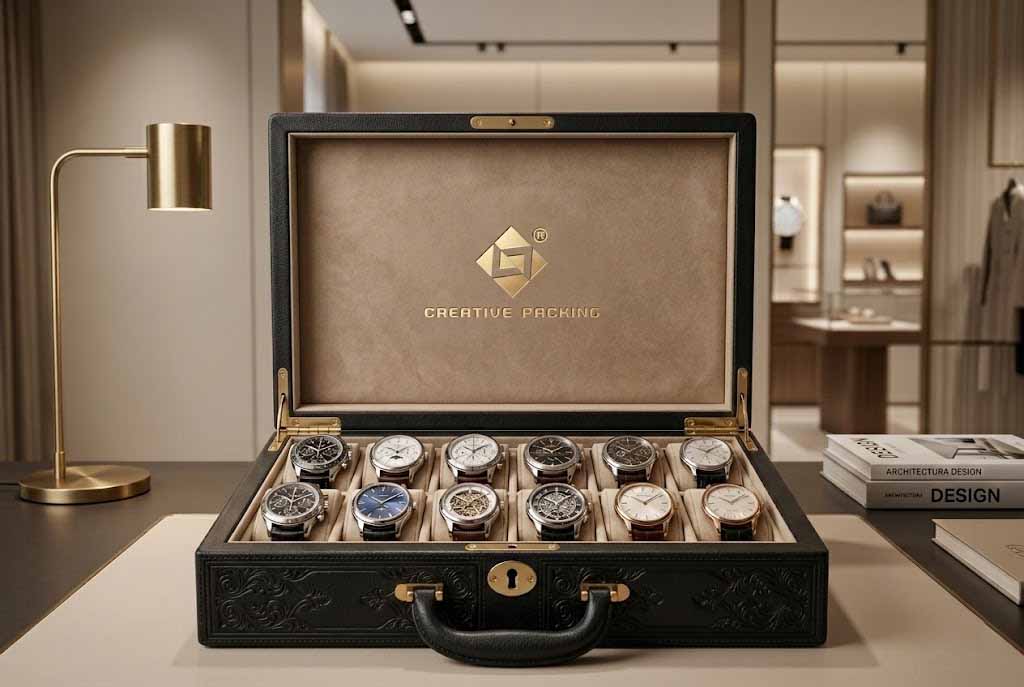
2. What “eco‑friendly watch box” actually means
In practical terms, an eco‑friendly watch box relies on:
l Sustainable materials (FSC‑certified paperboard, recycled wood, or responsibly sourced timber).
l Reduced material use (lighter boxes, thinner walls, and optimized structures).
l Non‑toxic or low‑impact inks and coatings (water‑based inks, vegetable‑based varnishes, and certifications like FSC or PEFC).
l Recyclable or biodegradable design (easy separation of materials, minimal plastic use, and clear recycling instructions where possible).
These principles do not necessarily mean sacrificing quality. A well‑designed eco‑friendly box can still feel substantial, look premium, and protect the watch effectively.
3. Designing for sustainability without losing luxury
There is a misconception that “eco‑friendly” equals “cheap” or “simple.” In reality, the opposite is often true. Many sustainable materials develop a unique texture and character that can enhance the luxury feel rather than reduce it.
l Natural wood with visible grain or light imperfections can emphasize authenticity and craftsmanship.
l Soft‑touch, matte paperboard with minimal printing can create a “quietly luxurious” aesthetic.
l Recycled materials can be used in innovative ways to create textured surfaces or patterned finishes.
Luxury brands can also express their commitment to sustainability through subtle visual cues. For example:
l A small icons or line of text indicating “FSC‑certified material” or “recyclable packaging.”
l Interior printed notes that explain the brand’s sustainability story and invite the customer to participate in responsible disposal.
These elements integrate environmental values into the brand narrative rather than presenting them as an afterthought.
4. Regional differences in sustainability expectations
Expectations around sustainability vary by region:
l In Germany, France, the Nordics, and the UK, many consumers actively look for eco‑labels and clear environmental information.
l In the United States, sustainability is an important factor, but it often mixes with questions of convenience and transparency.
l In the Middle East and parts of Asia, eco‑friendly packaging is still relatively new, but there is growing interest among younger, educated consumers and premium retailers.
For global brands, this means that an “eco‑friendly” watch box cannot be a one‑size‑fits‑all solution. In some markets, the focus may be on certifications and clear labeling; in others, it may be on visually subtle eco‑friendly signatures that still feel luxurious.
5. Manufacturing impact: beyond the material
True sustainability in luxury packaging also considers the manufacturing process:
l Energy efficiency of production lines.
l Waste reduction through optimized cutting and nesting of materials.
l Transportation efficiency by designing lighter, more compact boxes.
Choosing a manufacturer that prioritizes these aspects allows brands to reduce their environmental footprint across the entire supply chain, not just at the point of sale.
6. How to introduce eco‑friendly watch boxes to your brand
Introducing eco‑friendly watch boxes does not have to be a sudden overhaul. Brands can start by:
l Testing a pilot line using FSC‑certified paperboard or recycled wood.
l Clearly communicating the change to customers (“We’ve reduced box weight by 15%, using lighter, eco‑friendly materials”).
l Listening to feedback and adjusting designs over time.
At Creative Packing, we support international watch brands in developing sustainable watch box solutions that combine premium quality with environmental responsibility. We advise on material choices, structural optimization, and eco‑certifications, and help clients design and produce watch boxes that align with regional expectations and brand values. Whether you want to launch a fully eco‑friendly line or make incremental improvements to existing packaging, we can guide you from concept to production.
Related reading:
l How Materials and Finishes Shape the Value of a Watch Box
l From Drawing to Delivery: How Watch Box Design and Sampling Works Chinese Title
l Luxury Watch Box Design for the Middle East Market
l How to Choose the Right Watch Box for Luxury Brands
Previous: None
NEXT: None
Phone: +86 13538511868
E-mail: [email protected]
No. 13 Zhan North Road, Baisha Village, Humen Town,Dongguan City, Guangdong Province, China